- info@semraay.com



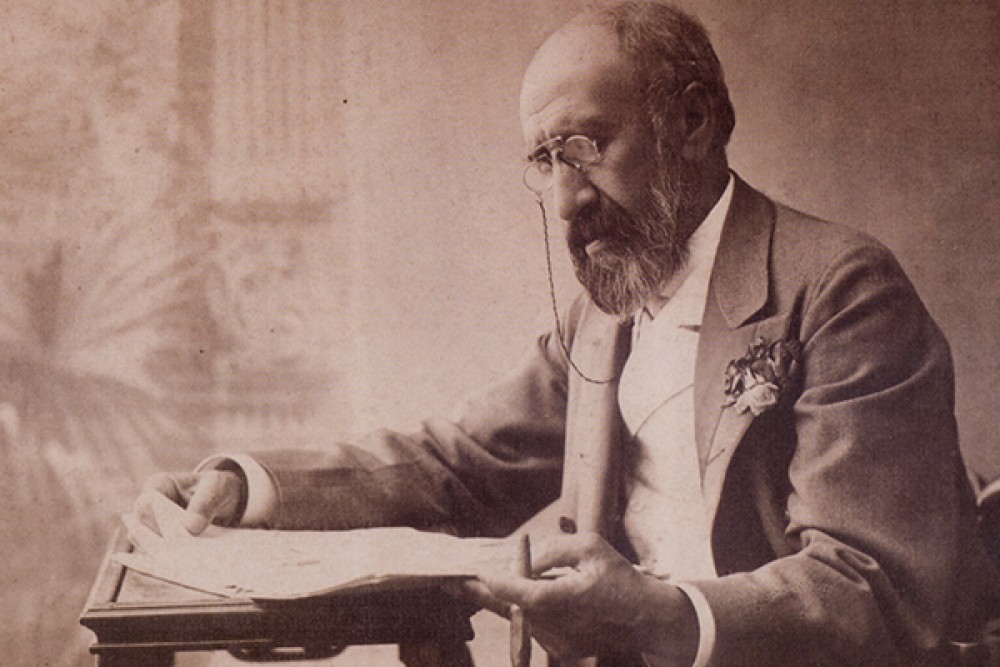
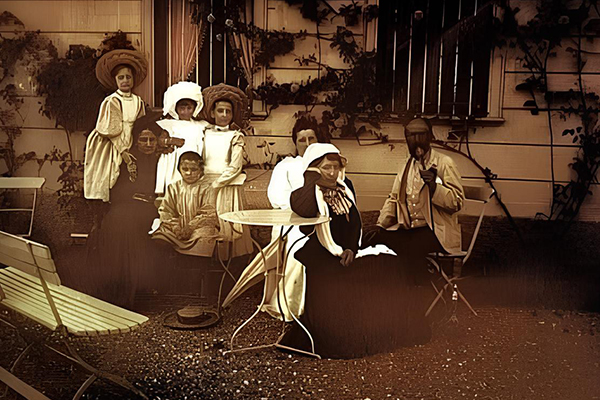
How well do you know Osman Hamdi Bey (1842–1910)? In addition to being a painter, statesman, archaeologist, museum director, and the founder of Mimar Sinan University, he was truly a man of mission. He removed women from being mere dogmatic symbols in his paintings. We can also observe the importance and value he placed on his wife and family through the photographs he had taken. In his family life, we see a very different Osman Hamdi—emotional, self-effacing, and always prioritizing his loved ones.
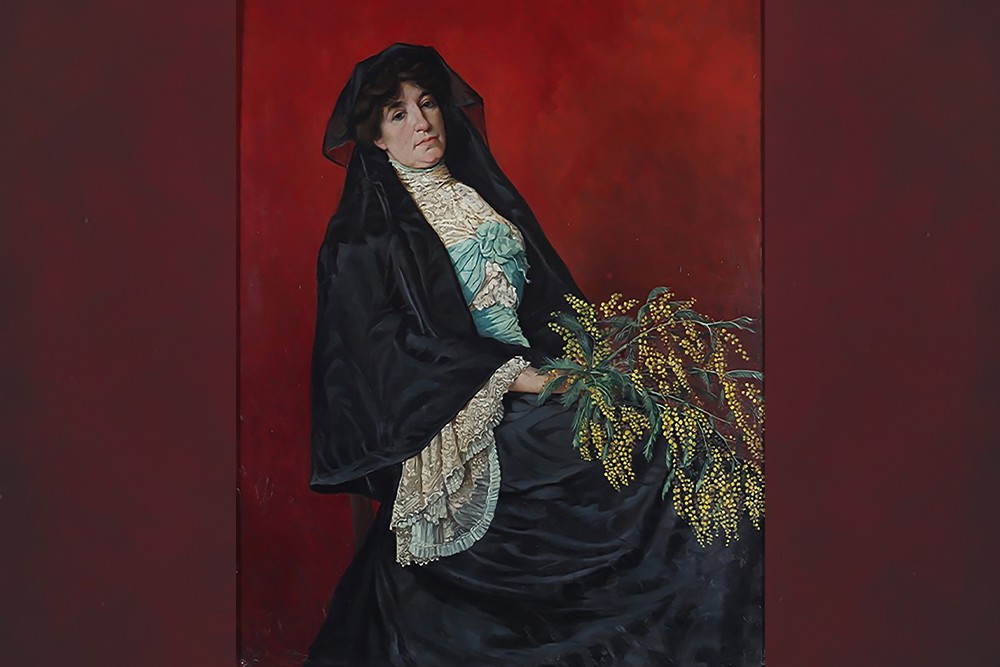
The work I would like to share with you today is “The Woman with Mimosas” (1906), an oil painting on canvas in which Osman Hamdi Bey portrayed his wife Marie (later known as Naile Hanım). At a time when women had scarcely appeared as central subjects on canvas, Osman Hamdi boldly chose to paint his own wife. Although he embraced an Orientalist style in many of his works, this painting reflects a distinctly different approach in terms of subject selection, depiction, and overall atmosphere. “The Woman with Mimosas” stands out clearly in this regard. The background is painted entirely in shades of red. This method directs all attention to the portrait itself. Our eyes focus on the facial expression, the subtle use of mimics, and the structure of the face. Had there been architectural elements or colorful ornaments in the background, our gaze would have been distracted, preventing full concentration on the figure.
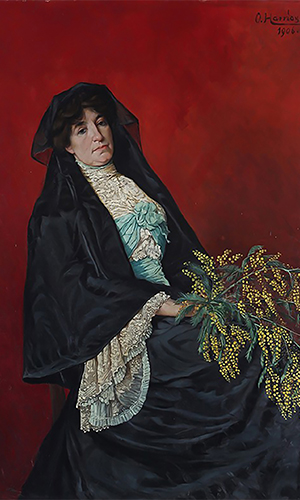
Osman Hamdi Bey, “The Woman with Mimosas”, 1906, Oil on canvas, Istanbul Painting and Sculpture Museum Collection
The use of red in the background can also be interpreted symbolically: just as love warms our hearts, Osman Hamdi expressed his affection and devotion to his wife through these red tones. On the right side of the background (behind the mimosas), there is an area formed by brushstrokes that resembles a dark mist. This can be interpreted as a representation of a love that remains vivid and alive. It also contributes to the depth of the composition.
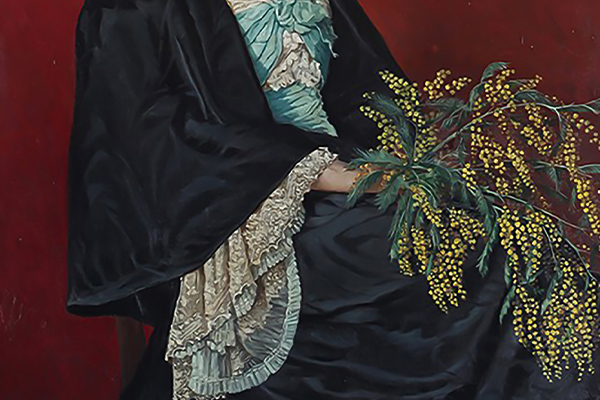
Another striking element in the painting is the clothing. The woman’s cloak is jet black, yet the dress underneath is made of satin-like, glossy fabric adorned with lace. Beneath the dark cloak, she presents a radiant and elegant appearance. This image also reflects a lifestyle oriented toward the West. Osman Hamdi Bey’s desire for progress and his Western-facing outlook can be observed in this and many of his other works.
And then there are the mimosas—symbols of love and spring. Blooming as spring approaches, mimosa flowers represent freshness, new beginnings, and womanhood. The reason for choosing yellow may lie not only in the emotions it symbolizes but also in its brilliance and visual impact. The intensity of the yellow and its contrast with the other colors immediately capture attention. Looking at the lower right corner of the canvas, we notice that the mimosas seem to extend beyond the painting itself. This approach dominates the composition, giving the impression that the flowers continue outside the frame, almost allowing us to sense their fragrance—just like his beloved Marie.
When you research mimosa flowers more closely, you will find that with their resilient branches and pleasant fragrance, they are often dedicated to women. It is unthinkable that Osman Hamdi Bey would have overlooked such a detail.
Marie’s posture is another noteworthy element. Rather than positioning the figure exactly at the center of the canvas, the artist placed her slightly to the left. Marie (Naile Hanım) is seated in a three-quarter view, though the chair becomes noticeable only upon careful observation. This manner of depiction moves beyond classical conventions and signals a more modern approach. As always, we see Osman Hamdi’s progressive attitude and his desire to transcend the classical tradition continuing in “The Woman with Mimosas.”
“The Woman with Mimosas” is currently part of the Mimar Sinan University Painting and Sculpture Museum collection. In 2020, through a collaboration between Mimar Sinan University and the Beyoğlu Municipality, a copy of the work was painted on the steps of Enli Yokuş in Kılıç Ali Paşa Neighborhood, Beyoğlu. This location was chosen because Osman Hamdi Bey once served as mayor in this district and was also the founder of Mimar Sinan University (Fındıklı/Beşiktaş). This joint project by the municipality and university painting students stands as a gesture of gratitude to Osman Hamdi Bey and the lasting legacy he left in the area.
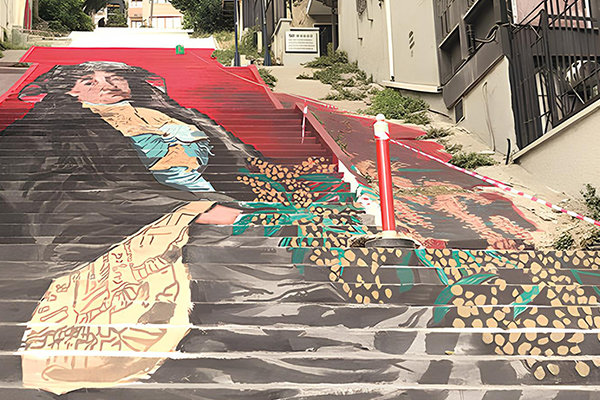
With thanks to the inspiring conversation between @gulvelikaya and @burcupelvanoğlu on the program “Bizim Resmimiz”! The episode in which I analyze Osman Hamdi Bey’s “The Woman with Mimosas” is now available on my Semra Ay Çırpan YouTube channel. Enjoy watching!
https://www.youtube.com/watch?v=WpAksaYoRXc
Copyright © 2021 Semra Ay Çırpan. All rights reserved.
Photography & Design: Roll Yapım